Monday, June 10, 2013

"Setting the Hook"

This weekend I landed an 18 inch Largemouth on Saturday and then a 21 1/4 inch Largemouth on Sunday.  Both of them were hooked with a green 7-inch power worm on a Texas rig.  I am fairly certain of two things which enable me consistently catch really big fish; 1) Fishing deep water 2) Using a big bait.  

But today I wanted to share my knowledge on how I set the hook on these big fish.  

The first thing I do when I feel a fish pick up my worm is to point the rod tip at the fish and slowly reel in any slack.  Once I feel I have taken up all the slack, I know I have pressure on the line.  The next step takes a bit of imagination, but at this point I imagine the bass' mouth is shut and he is swimming around with my plastic worm and hook inside his closed mouth.  I will then raise my pole from the 9:00 position to about the 10:30 position, or until I feel the weight of the fish.  What I am trying to do here is bring that worm and hook to the front of the bass' mouth.  For an analogy, imagine somebody pulling a spaghetti noodle out of your mouth and all you can do to try and stop it is to hold the noodle with your lips; unless at the end of that noodle there was a big meatball you could hold on to.  This is how I imagine the fishing line coming out of the bass' mouth.  At this time the eye of the hook is at the front of the bass' mouth (with the worm) and the pointy side of the hook is resting against the inside of  the bass' mouth, lined up like a surgeon resting the head of a needle against your skin.  When I bring my rod from the 10:30 position to the 12:00 position, I simultaneous give a the line a quick jerk by flipping my wrist to "pop" the hook quickly through the bass' mouth (hopefully, the top).

 In all, it is a little exhaustive process but I feel it gives me the strongest hook-set without without "ripping" the fish's mouth, gutting him with the hook or poking his eye out.

Here is the 18 inch Largemouth I caught Saturday using this hook set technique.


Wednesday, June 5, 2013

Texas Rigging in Early Spring

Last year I was really turned on to the Wacky-Rig 4" and 5" Senkos for fishing the Delaware.  And I learned what kind of awesome tool the Senko is in the river.  However, this Spring I am back to lake fishing and there is no greater setup then the 7" Power Worm on a Texas Rig.  My color of choice is dark green with black flecks.  I also like to put 3 or 4 red beads on my line as I feel their 'clacking' together resembles the Largemouth Bass' #1 predator during spawning season, the crawdad.

I usually put the Texas Rig worm weight on as it gives me more range and accuracy when I am fishing from my kayak.  However, given my new home at Lake Mohawk and my fishing from the docks, I suspect I'll do more flipping and will go with the natural fall of the worm.


Monday, June 3, 2013

My First Lake Mohawk Larry

It has been a crazy 2013 so far as I have had many big milestones to tackle; a destination wedding in Cozumel, MX, bachelor party in Las Vegas, a visit with Dad and taking the family to Disney.  The last of milestone I had was closing on a new home in Lake Mohawk, moving all my furniture and now renovating the old home for rental.  However, this past Friday we had a 3-family BBQ at Lake Mohawk and I got to make about a dozen cast with a green & pumpkin seed senko around sunset to nab my first Lake Mohawk Larry.

I have really grown fond of the Senko and almost exclusively rig it Jersey style.  Could be a good summer.


Tuesday, January 22, 2013

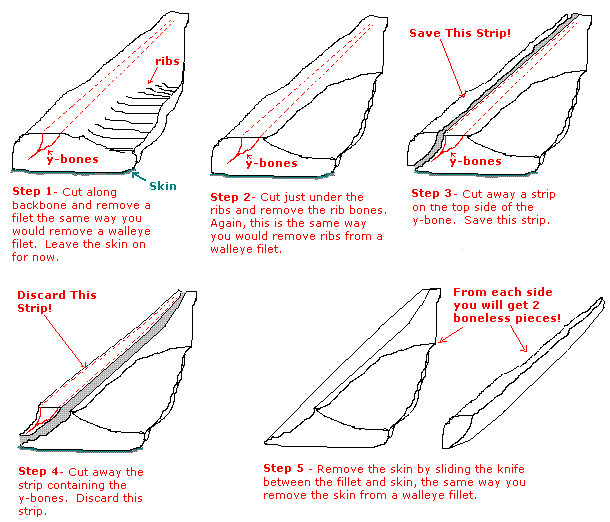
Filleting a Esox Americanus (Pickerel)

Last year was my first big year fishing in many years and my first big year fishing in Northern New Jersey.  I got an opportunity to eat some perch, largemouth bass, smallmouth bass, pickerel and walleye.  My personal favorite (and yes, I am bias being born in Minnesota) was the walleye, however my wife's favorite was the pickerel.  So this means two things for me in 2013:

1) If I want to be allowed to do more fishing next year, I better catch more pickerel
2) If I catch more pickerel, I have to do a better job of filleting the thing than I did last year

So I searched Youtube for some tutorials on filleting a pickerel.  I also search for videos on filleting a northern pike as they have the same bone structure.  Youtube is a tremendous resource for learning new skills and I was not let down again.  However, although most of the videos were pretty good, I never got that "A-HA" moment of exactly what the Y-bone looked like, exactly where it was in the fish and which direction the Y-Bone was positioned.  So I tried searching for images and I came across this very useful image.  As they say, a picture is worth a 1,000 words.


This image was created by Canoe Camp Fish

Saturday, December 1, 2012

Vertical Jigging for River Walleye

I have been on a bit of a dry spell fishing for walleye in the Delaware River, though I have seen others catching them.  With the air temperature dropping below 40 degrees, I have switched from nightcrawlers to shiners.  My preferred presentations have been lindy rigs and vertical jigging and I have targeted sunrise.  Today I am going to try to get on the river 45 minutes before sunset, approximately 4:00 PM. 

I found this helpful video on youtube and much of this knowledge is portable to the Upper Delaware River.  I have found Walleye hanging in the backwater sections of the Delaware River and for some reason I like the 13 to 16 foot depth..


Monday, October 22, 2012

Delaware River Was High and Muddy


I was entertaining guest this weekend, so I could only get out for a few hours on Sunday.  The fall afternoon was wonderful and I was hoping to snag some smallies on a 4-inch wacky rig.  I fished from about 2:00 to 3:30 and didn't even get a bite.  The water was high and muddy and the there were lots of leafs in the water. The Gage Height at Port Jervis, NY was about 5.3 feet.

I did get to try my neoprene waiters and they are a great addition to my arsenal of fishing.    I got a pair of Field and Stream (with no boot) waders and some accessory boots which go on over top the wader socks.  I figured I could still use the accessory boots in the Summer without wearing the waders.  There are some locations I fish on the Delaware that are just sooo rocky and potentially dangerous.  But even in the winter, these waders should keep me warm in the winter months, should I choose to fish the winter months.


I hear a lot groaning and moaning when the Delaware is high and dirty and my voice can now be added to the list.  I am still hoping for a few more good weekends to catch some more walleyes, as I think the bite will be good up to late November.


Monday, October 15, 2012

Walleye Fishing in the Delaware River


For those who know me best, I have been adamantly chasing walleye outside of the State of Minnesota (primarily in warmer climates) for some time, and with limited or no success.  So this summer was big for me as I was determined to eventually catch a keeper walleye.  This August I made another big push for walleye at Swartswood Lake and I only caught one fingerling (who my nightcrawler brought to the surface in a rear-naked-choke) and a 16-inch walleye after putting forth maybe 20 to 40 hours of lake time.  So I finally changed my tactics, gave up fishing for walleye in the summer and decided to revisit walleye fishing in October.  Well, Sunday was October.

To fish the Delaware in October, I bought myself a set of neoprene waders from Field and Stream to help stay dry and warm.  Comfort is everything when fishing and when the water is this cold, it is one of those things where you don’t realize how ‘not cold’ you are when you are ‘not cold’.  I am sure if I did not have these neoprene waders on  Sunday, I probably would have caught no fish and had a miserable time.

So Sunday morning I woke up and headed to Dingman’s Ferry.  The sun came up around 7:00ish and I was probably fishing by 7:30.  I focused on fishing behind the bridge pilings at Dingman’s Ferry as well as the backwater on the Pennsylvania side of the bridge.  Everything seemed perfect regarding water conditions as well as my presentation; a lindy rig with two floaters and a perch colors spoon on a worm harness.  As soon as my pole bent over and I picked up the pole, I immediately recognized the fish as a walleye with his lethargic fight and constant head-shaking!  I am sure my eyes were as big as saucers when I first saw this walleye about 2 feet below the surface.  He did not take me long to net him and he measured out at 20 inches and 4.1 pounds.  

New Jersey is starting to feel a bit more like home...


And a hand for perspective....